

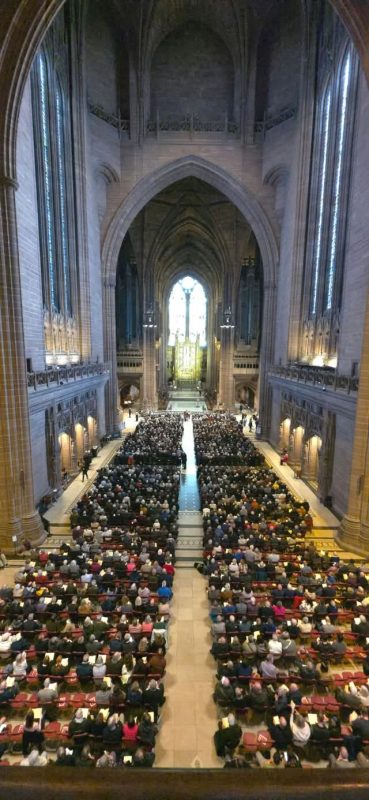
A Historic Day at Liverpool Cathedral: Celebrating 100 Years of the Willis III Organ and Honouring Ian Tracey
By Keith Harrington
Saturday, 17 October 2026, will go down in history for several reasons.
First and foremost, it marked the centenary of the fabulous Willis III Grand Organ at Liverpool Cathedral. Following the addition of the Echo division in 2024, the instrument is now more or less complete, or, at least, as complete as it is ever likely to be. The prospect of adding a two-manual-and-pedal division at the west end, housed in a beautiful case on Dulverton Bridge, remains a distant dream, given an estimated cost of perhaps £4 million.
With exactly 11,000 pipes arranged across ten divisions: Pedal, Choir, Positive, Great, Swell, Solo, Bombarde, Echo, Corona and Central distributed across five distinct locations and lofts within the cathedral, this is an immense instrument. Its sound quite literally surrounds you, encompassing everything from the gentlest flute stops, through an extraordinary variety of tonal colours and combinations, to the most commanding reed stops.
Published to coincide with the centenary, a new book by Peter Lynan, a former chorister and organ scholar, chronicles the first 100 years of this remarkable instrument. It is a must-read for any organ aficionado and is available in softback or a hardback limited edition from here.
A Centenary Celebration and a Farewell to Ian Tracey
The day will also be remembered for the one hundredth Choral Evensong and anniversary recital attended by over 1,800 people, which formally marked the retirement of Professor Ian Tracey as Cathedral Organist after an extraordinary 46 years in the post, having been appointed in 1980.
Throughout his remarkable career, Ian has played a vital role in sustaining and enriching the great tradition of English cathedral music. His powerful performances, impressive recordings and international concert appearances have earned him widespread admiration. Renowned for his profound musical knowledge and passionate interpretations, he has inspired generations of organists and music lovers alike.
His career reflects not only exceptional musicianship and technical mastery but also a lasting contribution to Britain’s musical heritage. His influence on Liverpool Cathedral and its musical life is immeasurable.
Midway through Evensong, immediately following the playing of Bach’s Fugue on the St Anne, Dean Sue Jones made an announcement that was warmly received by the congregation. Ian will continue to serve as one of the cathedral’s deputy organists, playing for services as required. Happily, therefore, he will not be lost to us in the organ loft.
The Dean also formally announced, to great acclaim, that the Chapter had appointed Ian as Organist Emeritus. This distinguished position has previously been held by his illustrious predecessors, Dr William Henry (Harry) Goss-Custard and Dr Noel Rawsthorne. It is a fitting recognition of Ian’s extraordinary service and enduring contribution to the cathedral.
Finally, Dean Sue announced that the search for Ian’s successor had concluded successfully. Martyn Noble will take up the position of Assistant Director of Music and Organist in the New Year.
Martyn is a distinguished British organist, pianist and accompanist, recognised for his outstanding musicianship and dedication to church music. In 2009, he was appointed Organ Scholar at Liverpool Cathedral, where, under Ian Tracey’s tutelage, he accompanied and conducted choral services while developing his considerable musical talents. He subsequently studied organ and piano at the Royal College of Music in London, graduating with first-class honours.
Martyn went on to become Sub-Organist and Acting Director of Music at the Chapel Royal, St James’s Palace, serving the Royal Household. His appointment represents a welcome continuation of the cathedral’s apostolic succession of organists, and I wish him every success as he takes on this important role.
A Recital to Remember
The service concluded with the traditional final hymn, Angel Voices Ever Singing, followed by an improvisation as the choir processed out. After a brief pause, Canon Myles Davies introduced the recital in his wonderfully lyrical style.
Ian began with Tournemire’s Improvisation sur le Te Deum, as transcribed by Duruflé, a magnificent choice with which to open the programme.
The remaining works paid eloquent tribute to three significant figures in the cathedral’s musical history: Goss-Custard, affectionately known as Gossy; Dr Noel Rawsthorne; and Flor Peeters.
Goss-Custard was represented by his arrangement of Bach’s Chaconne in D minor, while Rawsthorne’s contribution came through his Prelude on a Londonderry Air and Sortie on Nun Danket. Peeters was represented by his Lied Symphony.
The connection with Peeters was particularly poignant. It was well known that he regarded Noel Rawsthorne as his honorary musical son. By association, Ian might therefore be considered a musical grandson, a lovely reflection of the generations of musicians who have shaped this great cathedral’s musical life.
This was the first time I had heard the Lied Symphony in its entirety performed live. I could not help thinking that Ian really ought to record it for future generations. Such a recording would preserve his mastery of a work that is exceptionally challenging to perform and fits the magnificent resources of the Liverpool Cathedral organ like a glove.
No words can adequately convey the sheer wonder of this recital or the brilliance of Ian’s playing. At 71, when many might be content to take things a little more easily, Ian continues to perform to an impeccably high technical standard, with a sparkle, flair and musical authority that are all too rarely encountered.
He is certainly choosing to retire while still at the very top of his game!
Following a lengthy standing ovation and two encores, Ian’s formal duties for the day were complete. He soon found himself beneath Dulverton Bridge, where he obligingly signed more or less anything and everything presented to him, including copies of Peter Lynan’s newly published book and copies our own ChurchOrganWorld published sheet organ music customers had just purchased from us.
It was a fittingly informal and affectionate end to a day filled with music, history and heartfelt appreciation.
The Organists of Liverpool Cathedral
Dr Frederick William Burstall 1910 – 1916 (of the Lady Chapel only)
Dr Walter Henry (Harry) Goss Custard 1917 – 1955
Dr Christopher Noel Rawsthorne 1955 – 1980
Prof Ian Graham Tracey 1980 – 2026
Martyn Noble from 2027
A Personal Celebration
To round off the day, around 50 of Ian’s closest friends who were able to attend gathered at the local Chinese restaurant Mei Mei for a banquet in his honour.
I was particularly delighted that all 13 members of Team Harrington were present to share in such a wonderful occasion.
My youngest grandchildren may not remember the day when they grow older, but Grandad will do everything he can to ensure that they understand they were part of something truly special.
For this was more than a centenary celebration, more than a magnificent recital, and more than a farewell to a much-loved Cathedral Organist. It was a celebration of a remarkable musical legacy, of friendship and shared memories, and of the enduring place that music holds in our lives.
A hundred years of the Willis III organ. Forty-six years of Ian Tracey. One unforgettable day at Liverpool Cathedral.
